Saturday, 13 September 2014

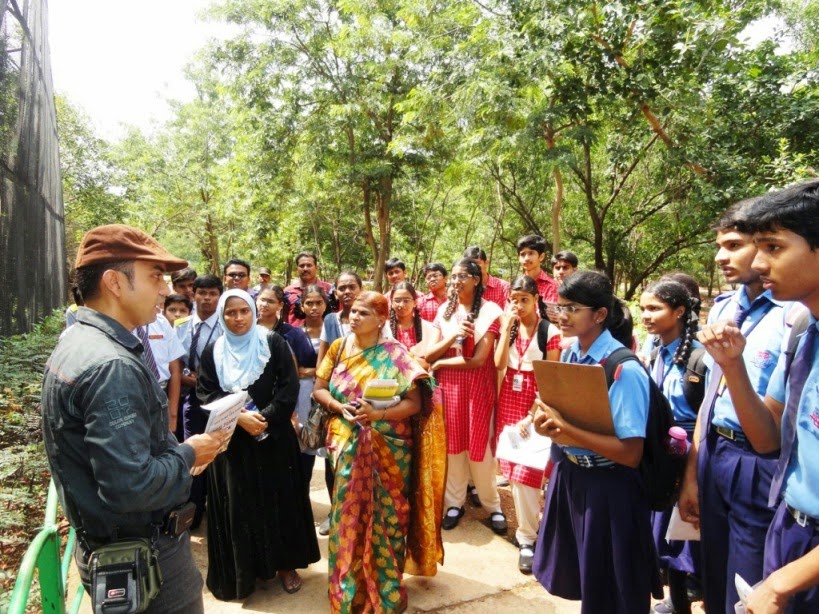
Conservation Education and Awareness

We believe that raising awareness and educating public about environment and wildlife is the key to conservation. We carry out number of education programmes, awareness talks, lectures and workshop to students, teachers, general public and local residents through out the year on various issues pertaining to wildlife conservation and environment protection.


Competitions for school students on environment and wildlife related topics


Friday, 12 September 2014

King Cobras sighted and killed in north coastal Andhra Pradesh


King Cobras are the largest venomous snakes in the world. They are protected under the Indian Wildlife (Protection) Act, 1972. They play a key role in the ecosystem as one of the top predators. However, ignorant locals kill them on sight unnecessarily out of fear and false-beliefs. The Eastern Ghats Wildlife Society is carrying out education and awareness programmes in these villages of north coastal Andhra Pradesh to enlighten the public about the significance of these rare snakes. Please help us intensify our conservation efforts through your support. Your contributions are highly valued.


Conservation of King Cobras in Andhra Pradesh


The king cobra or hamadryad (Ophiophagus hannah) is the world’s longest venomous snake, with recorded lengths of over 5.5 meters (Aagaard, 1924). King cobras are listed in Schedule II of the Indian Wildlife Act, and as vulnerable in IUCN (see http://www.iucnredlist.org/details/177540/0). In India their range extends across the Western and Eastern Ghats, sub-Himalayan region and Northeast India; with their habitats varying from humid tropics to sub-tropical and mangroves. Our study site is mixed dry thorn scrub forests with temperatures over 40oC; drier, compared to other king cobra habitats in India. Currently considered as monotypic genus, king cobras are cryptic species likely to be recognized, bringing the Eastern Ghat’s king cobras up for a status re-evaluation. Paucity of data hinders assessing its ecological and conservational status. Unlike in Agumbe (Western Ghats), people here do not tolerate king cobras, with killings reported once every two months in the last six months (many unreported).   Huge tracts of forests in Eastern Ghats have been lost to development, much of it irreplaceable strongholds of biodiversity. Due to anthropogenic and political sensitiveness, studies about the region's biodiversity particularly king cobras, have been sparse. By using a combination of research, education and interaction, our study will assist the Government in identifying forests worthy of protection based on the presence of king cobras, a potential flagship species of this region.
 
The king cobra (Ophiophagus hannah), is a top predator and an icon of the rainforest. Through research and education programmes throughout king cobra habitats of Andhra Pradesh we aim to gain further knowledge of king cobra for conservation and human snake conflict mitigation. The data collected will be used to advise the creation of protected areas, using the king cobra as an umbrella species under which the habitat and biodiversity of the Eastern Ghats can be conserved.
Being an apex predator, king cobras are indicative of the health of herpetofauna of the region. Hence apart from studying king cobras, a study of their prey base and the overall status of the region’s herpetofauna will be assessed.


Coupled with the data that we are collecting from this project, we believe that we will be able to bring out a comprehensive understanding of the king cobra, its habits and natural history that will enable the functional conservation of this iconic species.
 
AIMS


  • To estimate historical and current records of occurrence and abundance, predicting occurrence, distribution, establishing presence or absence of king cobras in the region (probably an isolated or peripheral population) through surveys.
  • Breeding biology (monitoring mating pairs and nests).
  • The dwindling forest cover push king cobras in conflict with humans, and with almost zero tolerance, they get killed.  We will collect data essential for assessing human-snake conflict, and develop tangent measures to minimize it.
  • Through reptile and amphibian surveys the overall status of the prey base and herpetofaunal strength will be assessed.
  • By involving students, forest officials and local communities, we will create awareness through educational campaigns and drives.
Our larger vision is to establish a permanent field station for the study of king cobras and to carry out long term monitoring.


A dead king cobra preserved at a science college in Srikakulam.


King Cobra feeding on a snake in the reserve forests of  Maredumilli
 

Historical Records and Sightings of Fishing Cats

Rail road kill of fishing cat near Sompeta, Srikakulam.

Fishing cat captured at Kakinada


A kitten rescued at Sorlagundi.

Rescues fishing cat near Machilipatnam


Fishing Cat Documentation

We have recorded the southern most population of fishing cats in India near Krishna Wildlife Sanctuary, Andhra Pradesh.

Scat

Paw prints of a male fishing cat


Dried tracks in the mud


Rare camera trap photos showing natural behaviour of fishing cat in its habitat.

Thursday, 11 September 2014

Setting up camera traps in the mangroves to document the presence of Fishing Cats


An installed camera trap ready for action


Questionnaire surveys in the villages and interaction with locals around the fishing cat habitat


Monday, 8 September 2014

Fishing Cat Conservation in Andhra Pradesh


In India, fishing cats are mainly found in the mangrove forests of the Sundarbans, on the foothills of the Himalayas along the Ganga and Brahmaputra river valleys and in the Western Ghats. The fishing cat is included in Schedule I of the Indian Wildlife (Protection) Act, 1972 and thereby protected from hunting. On the east coast of India, only a few intact small populations of fishing cats are known to occur, and these are subject to heavy habitat loss, persecution and poaching by humans. To date, there have been no extensive surveys on the occurrence of a fishing cat population, their habitat and diet requirements, in the Eastern Ghats of Andhra Pradesh. Only two published records from the Coringa Wildlife Sanctuary mangroves (Kolipaka 2006, Mukherjee et al. 2012) apart from couple of recent reports from local news papers. Besides, only anecdotal information exists on the distribution and ecology of the species in this region. Therefore, we felt an urgent need to carry out long-term conservation measures to save the species from local extinction.

We have documented fishing cat presence ( tracks, scat, historical sightings, road kills and camera trap photos) in the following areas along the east coast of Andhra Pradesh.
Click on the link below to see the map


Project Objectives


  • Set up remotely triggered wildlife cameras to document the presence/absence of fishing cats in and around wetland habitats suitable for their occurrence.
  • Document any prevalent threats (such as habitat encroachment, pollution of wetlands from nearby towns/villages, poaching, persecution and retaliatory killing) and their severity against the survival of fishing cats.
  • Collect other direct and indirect evidence of fishing cat occurrence (such as scats, pugmarks, and sightings by local people) along with documentation of historical knowledge and records of fishing cats in and around wetland habitats.
  • Develop GIS-based habitat maps for fishing cats in south India (with the use of data collected as part of objectives 1-3).
  • Promote awareness among local people living in towns/villages near fishing cat habitats through conservation education programmes, thus motivating them towards community-based conservation of fishing cats and their habitat.

We identified the following potential sites in Andhra Pradesh under Phase-I to survey for fishing cat occurrence.